There are updates that refine a Product, and updates that redefine its direction. WebWall 2.1 belongs firmly to the second category.
With the “Stay Puft Edition“, WebWall evolves into a more structured, more capable, and more responsive security system. It remains fully standalone, written in pure PHP, and intentionally free from unnecessary dependencies, but its internal architecture has grown into something more ambitious. Multiple SQLite engines, a more refined buffering strategy, a stronger scoring model, and experimental edge enforcement all move in the same direction: giving WebWall more awareness, more precision, and more resilience under pressure.

If the Gozer Release introduced the idea of behavioral defense, the Stay Puft Edition turns that idea into a more mature and distributed security model.
A more distributed core
The most significant change in v2.1 is the move toward a multi-engine SQLite architecture, for short-term memory management; MySQL remains the fixed point for data storage, adhering to the timelines specified by the Administrator (GDPR Safe). Instead of concentrating every responsibility into a single database, WebWall now distributes its workload across dedicated nodes. Core manages configuration and identity. Pulse handles real-time traffic and buffering. Ane “Slimer” maintains bot intelligence and CIDR data. Vigo coordinates edge synchronization.
This is not only a technical improvement, but an architectural one. By separating responsibilities, WebWall reduces write contention, improves clarity, and makes each subsystem easier to evolve independently. The result is a system that remains lightweight, but is much better prepared to operate under sustained traffic and real-world pressure of the Website.
Gozer, now pressure-aware
“Gozer” has also been refined. In earlier versions, its strength came from behavior-based scoring and incident aggregation. In v2.1, it becomes even more aware of the environment around it by introducing a broader pressure model. Instead of looking only at isolated events, it now evaluates traffic volume, unique visitors, incident density, ban activity, and latency as part of a more complete picture of system stress. This matters because attacks are not always loud. Some arrive slowly, accumulating pressure over time until the system begins to feel the strain. By incorporating pressure into its decision-making process, “Gozer” can recognize not just malicious behavior, but the conditions that make malicious behavior more dangerous.
The addition of trend detection makes that logic even more useful. A system can react to what has already happened, but it is far more valuable when it can sense whether the situation is stabilizing, worsening, or moving toward a more serious escalation.
Edge protection, when it counts
The native Cloudflare integration also becomes more expressive in v2.1. WebWall continues to support IP List synchronization, but the Stay Puft Edition introduces an experimental layer built around Cloudflare D1 and Workers. This is a powerful option, but deliberately not a simple one. It is designed for users who understand the added complexity and want to push WebWall beyond origin-only protection. That is an important part of the WebWall philosophy. The system should be capable of reaching the edge when needed, but it should never force unnecessary complexity on those who do not want it. In other words, the edge is available as a weapon, not as a requirement.
A dashboard with more meaning
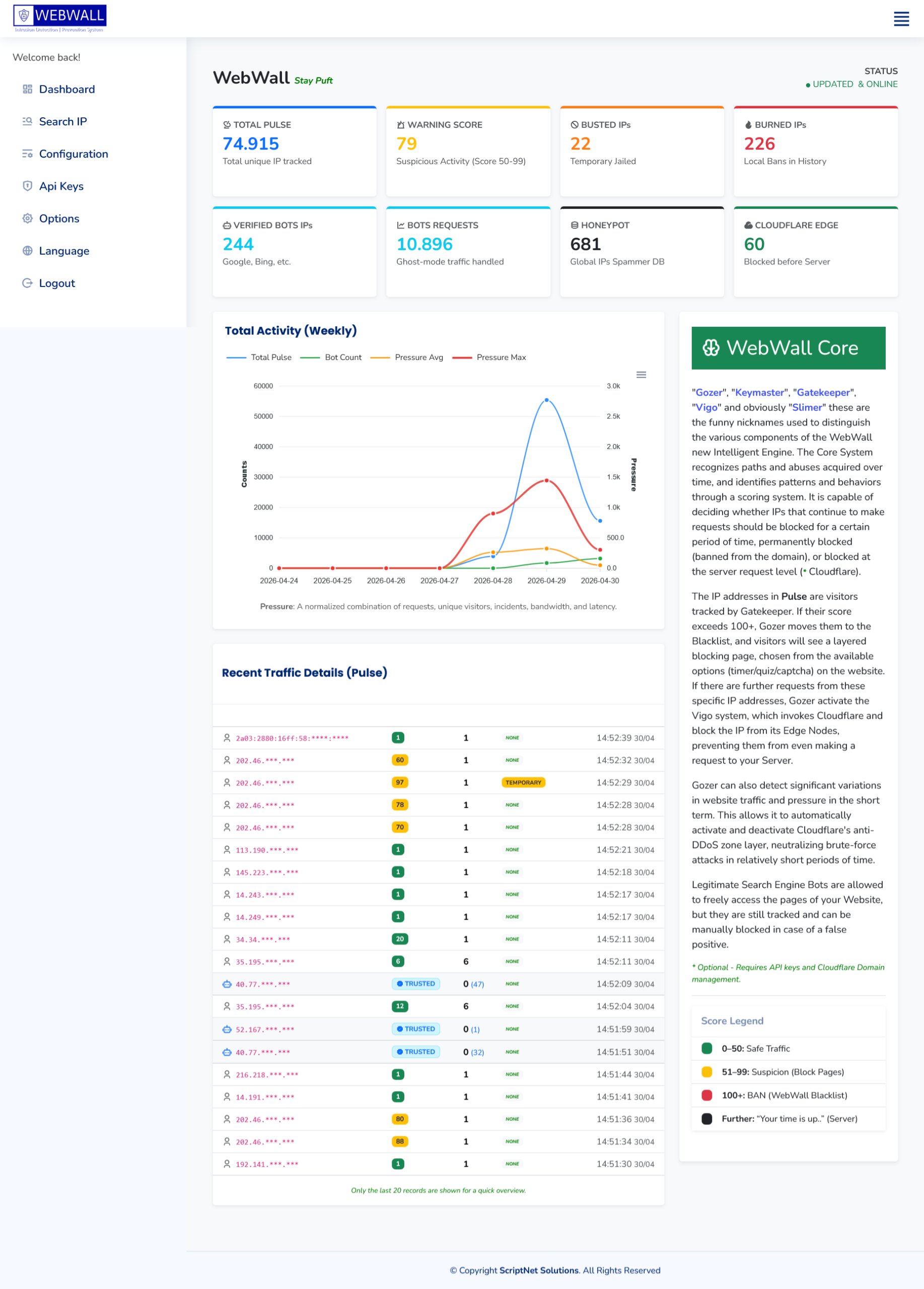
As the system grows, the dashboard grows with it. The enhanced interface does more than display counters: it gives the administrator a clearer sense of the system’s state, its pressure, and its behavior over time. Warnings, temporary jail, permanent bans, verified bots, honeypot activity, bot traffic, and edge-level blocking are now easier to interpret at a glance. That matters because a good security system should not only defend well; it should explain itself well. Visibility builds trust, and trust is essential when a system is making decisions on your behalf. WebWall’s dashboard is becoming not just a reporting surface, but an operational one.
Built for practical control
The new version 2.1 “Stay Puft Edition” does not try to be simple in a superficial way. It tries to remain controlled.
Every new feature has a purpose. Multi-engine storage exists to reduce contention and keep the system stable. Pressure analysis exists to improve behavioral judgment. Edge enforcement exists to stop threats earlier in the chain. None of these additions are there for spectacle alone. They are there because they help WebWall stay what it has always wanted to be: standalone, direct, practical, and just a little nerdy. That, in the end, is still the WebWall philosophy 😏.
Moving forward
If the Gozer Release gave WebWall a stronger brain, the Stay Puft Edition gives it a better body, better sensors, and a much deeper awareness of what pressure really means.
It still watches. It still scores. It still blocks.
But now it does so with a more distributed architecture, a more nuanced view of behavior, and a clearer path to the edge when the situation demands it.
And yes, it still carries exactly the right amount of Ghostbusters in its DNA!
Discover WebWall – Live Demo
Buy Now WebWall v2.1 – Stay Puft Edition with 20% off limited offer